Staff Training Gaps: Why Your Team Needs Allergen Support Tools
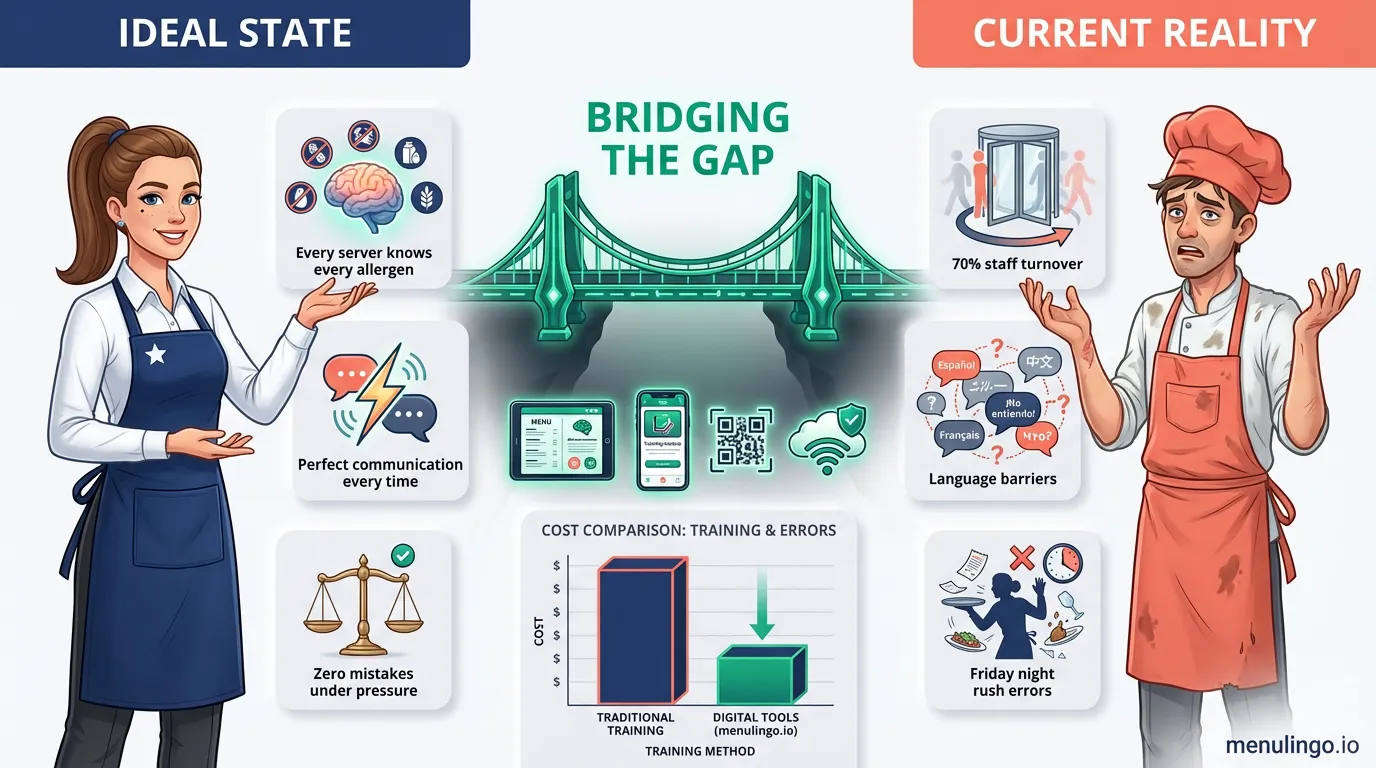
In a perfect world, every server in your restaurant would know every ingredient in every dish, understand the 14 major allergen categories, and communicate that information clearly to every diner who asks — in any language. In reality, that's almost impossible.
The Turnover Problem
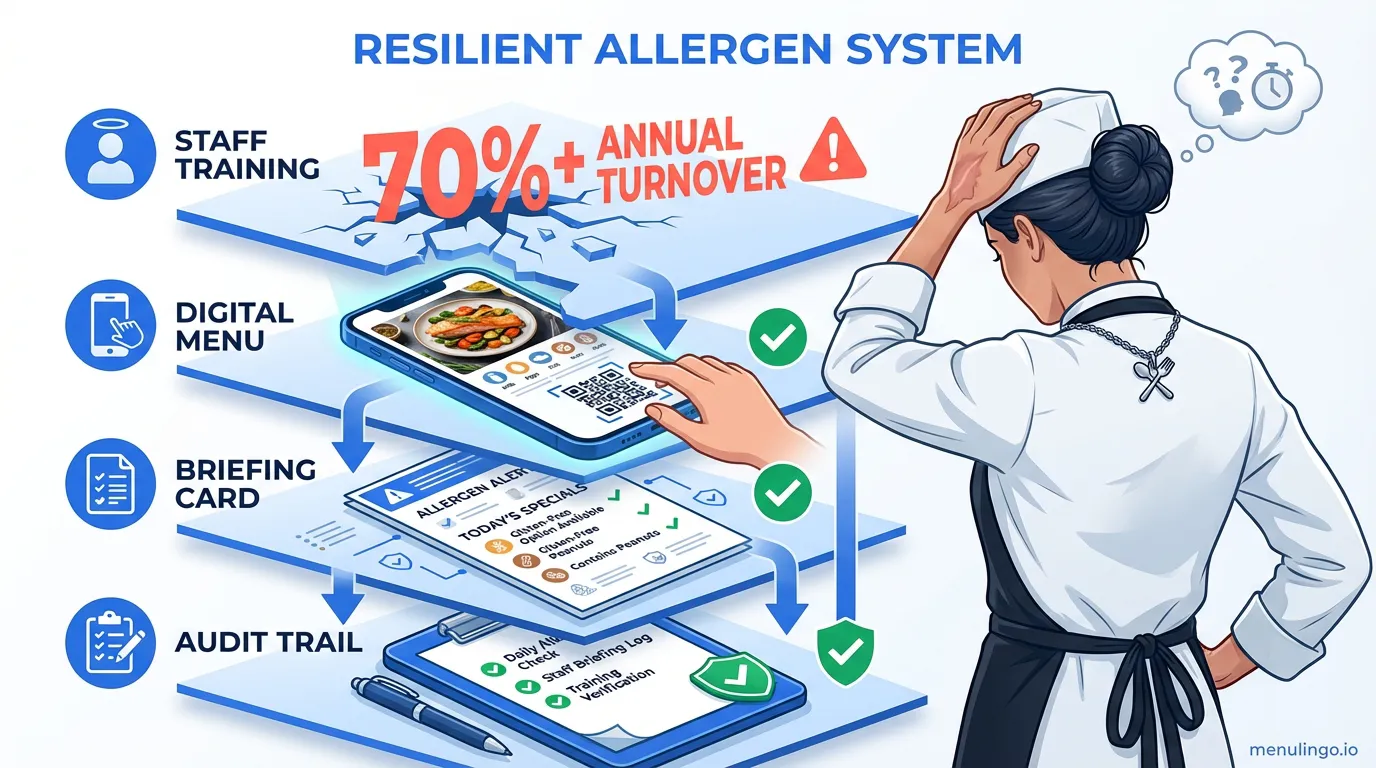
Hospitality has one of the highest staff turnover rates of any industry. In Australia, annual turnover in food service routinely exceeds 70%. In the US and UK, the figures are similar. This means the majority of your front-of-house team has been with you for less than a year.
Every new hire needs allergen training. Every training session takes time from service. And every time a trained staff member leaves, the knowledge walks out the door with them.
The practical result is that at any given moment, a significant portion of your floor staff may not have complete, current allergen knowledge. During peak periods — when allergen communication matters most — these knowledge gaps become real risks.
The Friday Night Scenario
Picture a busy Friday night. The dining room is full, the kitchen is running 20 minutes behind, and three tables have just arrived simultaneously. A diner at table 12 asks the server about tree nuts in the lamb dish. The server isn't sure. They need to go to the kitchen to check.
Meanwhile, table 7 has a diner who speaks limited English and is trying to communicate a dairy allergy through gestures. The host is managing the wait list and can't assist. The server at table 7 nods and writes "no cheese" on the order — missing the butter in the sauce, the cream in the mash, and the milk in the bread.
This isn't a training failure. It's a systems failure. No amount of training can make every staff member an allergen expert in every language during the busiest service period of the week.
What Training Can and Can't Do
Good allergen training teaches staff the basics: what allergens are, why they matter, how to respond when a diner asks. This foundation is essential and non-negotiable.
But training has limits. Staff can't memorise every allergen in every dish, especially when the menu changes seasonally. They can't communicate allergen information in languages they don't speak. They can't guarantee accuracy under time pressure when the kitchen is slammed and the dining room is at capacity.
Training works best when it's supported by tools that make the right information available at the right time — without relying on memory.
The Paper Allergen Matrix Problem
Many restaurants create a paper allergen matrix — a grid showing dishes along one axis and allergens along the other, with markers showing which dishes contain which allergens. This is a good start, but it has practical limitations.
The matrix needs updating every time a dish changes. If the kitchen substitutes an ingredient (even temporarily), the matrix becomes inaccurate. Staff need to remember to check it — and during a rush, checking a printed sheet that's pinned to the wall near the POS system isn't always practical.
The diner never sees the matrix directly. The information goes through the server's interpretation, which introduces another potential point of error.
Digital Tools as a Safety Net
A digital menu with built-in allergen information addresses the gaps that training and paper matrices leave open.
For diners: They can see allergen information directly, in their own language, without asking a server. They can filter the entire menu by their allergens and see only safe dishes. This happens on their device, privately, before they order.
For staff: When a diner does ask about allergens, the server can pull up the digital menu on any device and show the exact allergen information for any dish. No memory required, no kitchen trip needed, no language barrier.
For managers: The allergen information stays accurate because it's tied to the menu items in the system. When a dish recipe changes and allergens are updated, the information available to diners updates immediately.
The Briefing Card Approach
Some restaurants combine digital menus with printed briefing cards — a single-page A4 allergen summary that staff can reference during service. The briefing card shows all current menu items with their allergen status in a quick-scan grid format.
This hybrid approach works well: the digital menu handles diner-facing allergen communication (including multilingual support), while the briefing card gives staff a physical reference they can check during service.
Building a Resilient System
The goal isn't to replace staff training. It's to build a system where allergen safety doesn't depend entirely on any single person's memory or availability.
A resilient allergen system has multiple layers: trained staff who understand allergen basics, a digital menu that gives diners direct access to allergen information, a briefing card for quick staff reference, and an audit trail that records when allergen information was last confirmed.
When all four layers work together, a busy Friday night with three new servers still has the same allergen safety standard as a quiet Tuesday with your most experienced team.
Explore how MenuLingo's digital menu system supports your allergen management. View plans and pricing or start a free trial.
Ready to make your menu multilingual?
Join restaurants already serving diners in 9 languages with accurate allergen information. 14-day free trial, no credit card required.
Start Your Free Trial