Why Google Translate Fails for Restaurant Menus
Every restaurant owner has had the thought: "Why not just run the menu through Google Translate?" It's free, it's fast, and it handles most languages. But the results for restaurant menus range from awkward to dangerous.
The Culinary Context Problem
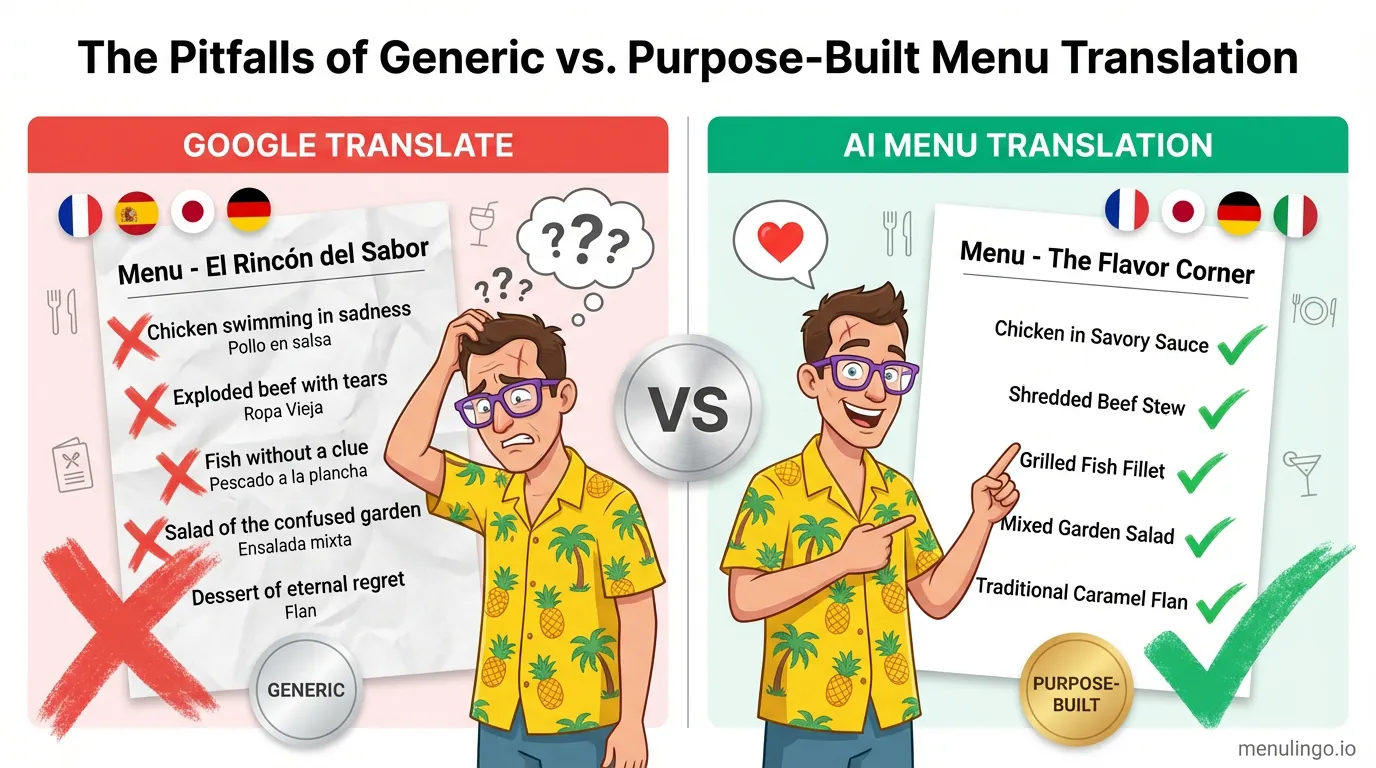
Google Translate processes text without understanding what it's translating. It doesn't know the difference between a cooking technique and a place name. It doesn't understand that "confit" refers to slow-cooking in fat, not a type of jam. It doesn't recognise that "rocket" on an Australian menu is a salad leaf, not a spacecraft.
Consider a dish listed as "Pan-seared duck breast with cherry jus on a bed of wilted rocket." Google Translate into Mandarin Chinese might produce something technically correct word-by-word, but the result reads like a mechanical assembly rather than a dish description. A native speaker would find it confusing or even comical.
Allergen Information Gets Lost
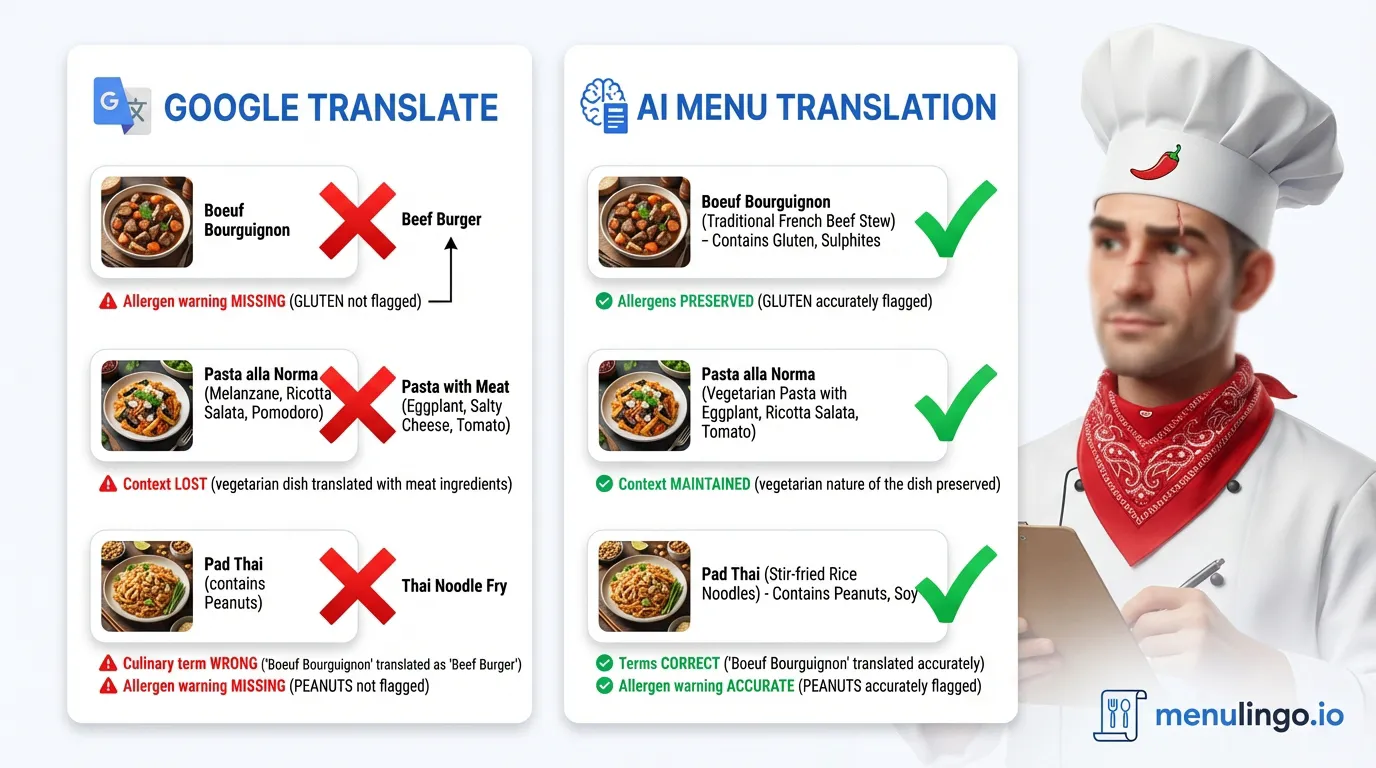
This is where generic translation becomes genuinely risky. Understanding all 16 major food allergens is critical for any restaurant. When allergen information is embedded in a dish description — "contains tree nuts" or "prepared in a kitchen that handles shellfish" — Google Translate may rephrase, soften, or restructure the warning in ways that change its meaning.
In some languages, Google Translate has been observed dropping qualifiers entirely. "May contain traces of peanuts" might become simply "peanuts" — which changes a precautionary statement into an ingredient declaration. For a diner making decisions based on this information, the consequences can be severe.
Regional Ingredients Have No Direct Translation
Australian cuisine uses dozens of native ingredients that have no equivalent in other languages. Finger lime, lemon myrtle, Davidson plum, pepperberry — these need descriptive translations, not dictionary lookups. Google Translate either leaves them untranslated (useless to the diner) or substitutes the closest dictionary match (misleading).
The same applies to regional dishes worldwide. Japanese menu items, Thai curries, Italian regional specialties — each carries cultural context that a generic translator strips away.
Formatting and Structure Break
Restaurant menus have a specific structure: dish name, description, price, allergen markers, dietary labels. Google Translate treats the entire text as a single block of prose. The output loses the distinction between the dish name and its description, mixes up price annotations, and strips formatting markers.
For a QR code digital menu where the diner needs to scan, read, and decide quickly, broken formatting is a deal-breaker.
The "Good Enough" Trap
Some restaurant owners accept that Google Translate isn't perfect but figure it's "good enough." The problem is that diners don't grade on a curve. A poorly translated menu signals that the restaurant doesn't care about international guests. For tourism-heavy locations, this directly impacts revenue.
More importantly, "good enough" doesn't apply to allergen information. With allergen regulations tightening worldwide, allergen communication needs to be accurate, not approximate. There's no acceptable margin of error when a diner's health is at stake.
What Purpose-Built Translation Does Differently
AI translation tools designed specifically for restaurant menus solve each of these problems. They understand culinary terminology, preserve allergen warnings with exact phrasing, handle regional ingredients through descriptive translation, and maintain menu formatting throughout.
The difference is context. A purpose-built menu translation system knows that "rocket" is arugula, that "jus" is a sauce, and that "contains tree nuts" is a safety-critical statement that must be preserved exactly in every language. Google Translate doesn't make those distinctions.
The Practical Test
If you're unsure whether your current translation approach is adequate, try this: translate your menu into Mandarin Chinese using Google Translate, then show the result to a native Mandarin speaker. Ask them to order from it. The feedback will tell you everything you need to know.
Ready to switch from generic to purpose-built? See MenuLingo pricing or start your free trial.
Ready to make your menu multilingual?
Join restaurants already serving diners in 9 languages with accurate allergen information. 14-day free trial, no credit card required.
Start Your Free Trial