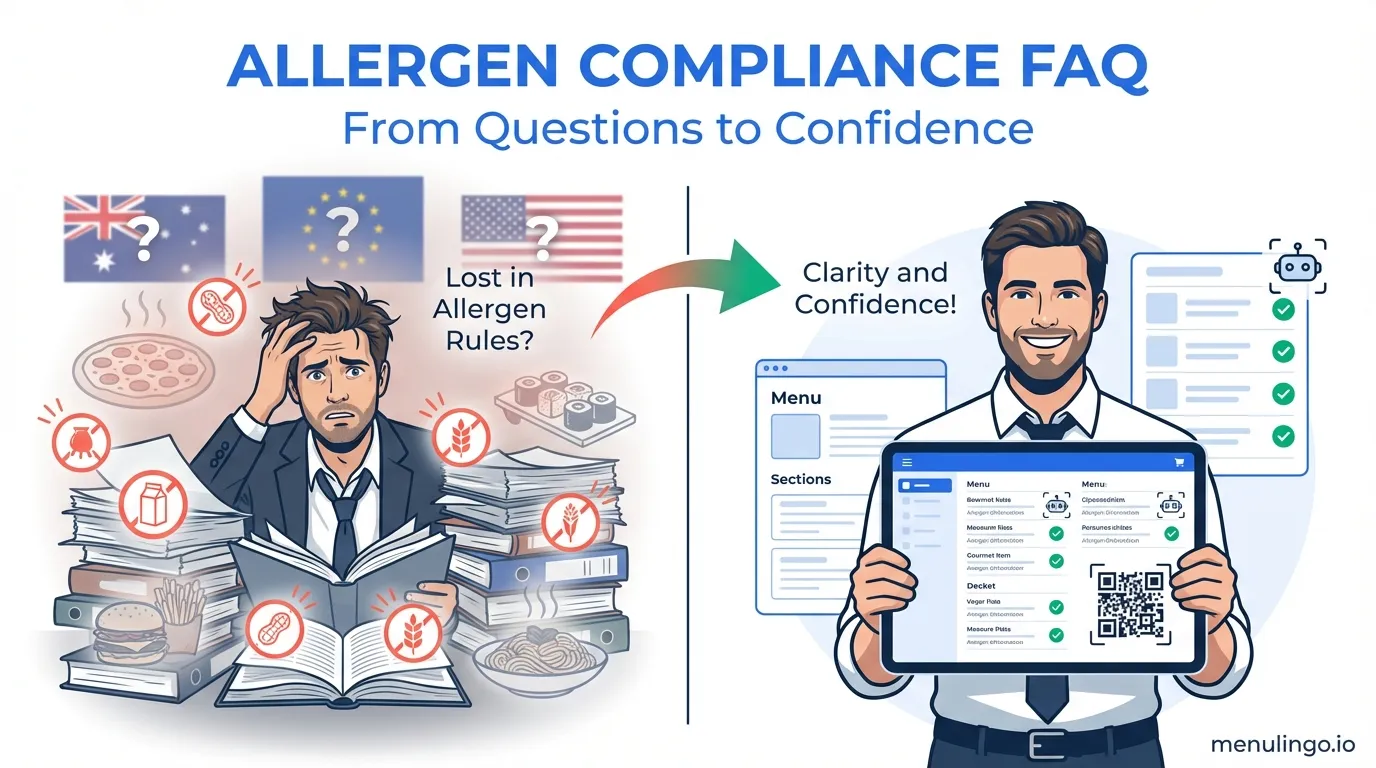
AI Allergen Compliance FAQ: What Restaurant Owners Need to Know
Allergen compliance is one of the most stressful responsibilities a restaurant owner faces. Get it right and nobody notices. Get it wrong and you're dealing with medical emergencies, legal claims, and reputation damage that can take years to recover from.
With new regulations tightening across Australia, the US, and the EU, it's no surprise that restaurant owners are asking more questions than ever. Here are the most common ones — with practical, fact-based answers.
What allergens do I need to declare in Australia?
Australia requires food businesses to declare allergens listed in the Food Standards Code. The mandatory allergens include peanuts, tree nuts, milk, eggs, fish, shellfish (crustaceans), wheat, soybeans, sesame, and lupin. Additionally, sulphites at concentrations of 10mg/kg or more must be declared.
The PEAL (Plain English Allergen Labelling) transition period ends in February 2026, which means allergens must be declared in clear, plain English — not buried in scientific terminology or footnotes.
For a complete breakdown of all 16+ allergen categories tracked across jurisdictions, see our guide on the 16 major food allergens every restaurant must know.
How do allergen laws differ between countries?
The short answer: significantly. The EU requires 14 allergens to be declared under Regulation 1169/2011. Australia mandates a different set under the Food Standards Code. The US is rolling out state-level legislation, with California's allergen law taking effect in July 2026 for restaurant chains with 20 or more locations.
Each jurisdiction defines its own list, its own enforcement mechanisms, and its own penalties. If your restaurant serves international tourists — or operates across borders — you need a system that understands the differences. Our worldwide allergen regulations guide covers the specifics.
Can AI help with allergen detection on menus?
Yes — and increasingly, restaurants are turning to AI-powered tools to reduce human error. Here's how it works in practice:
AI analyses each dish description, ingredient list, and recipe to identify potential allergens. It cross-references against a comprehensive allergen taxonomy and flags items with a confidence score. The higher the confidence, the more certain the system is about the presence of a specific allergen.
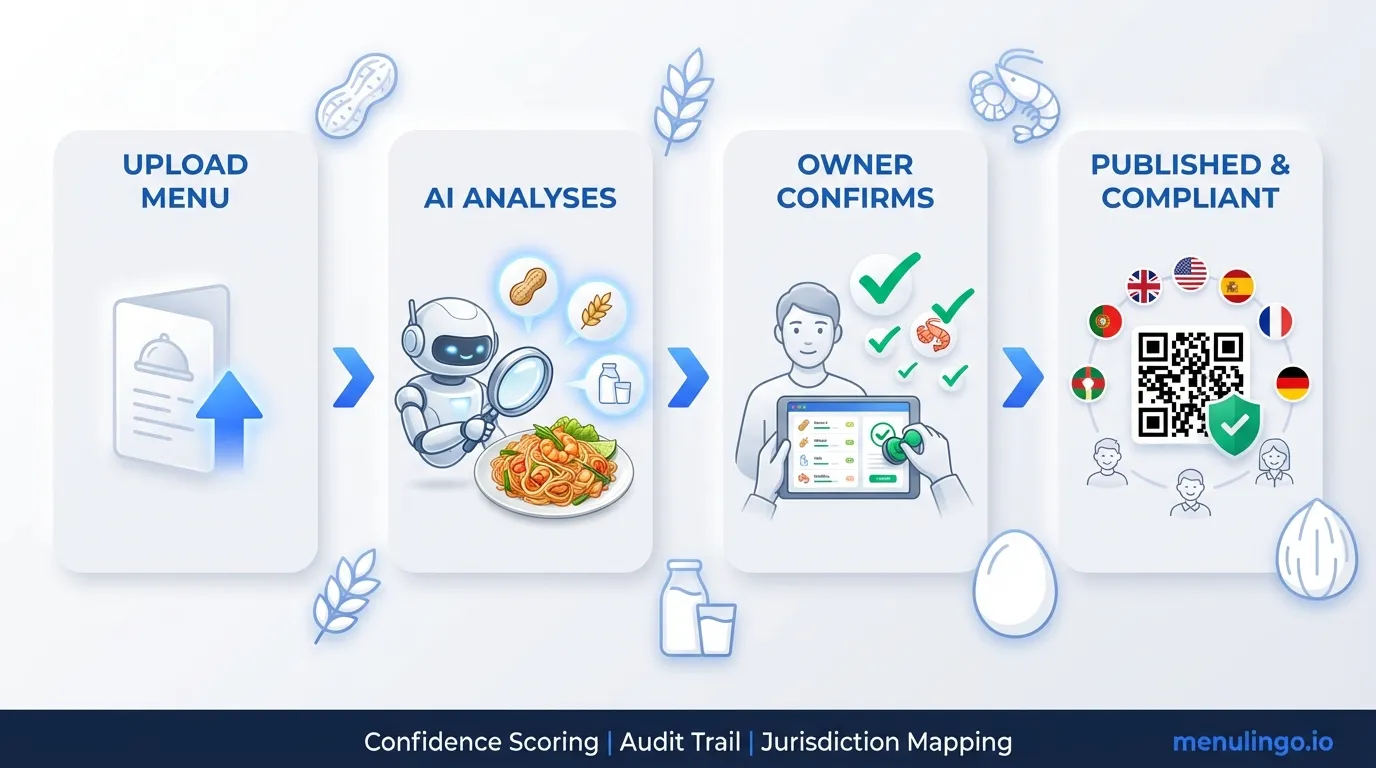
The critical point: AI should suggest, not decide. Any responsible system requires the restaurant owner to review and confirm every allergen before it's published. This "confirmation gate" ensures that the human with kitchen knowledge has the final say.
MenuLingo uses this exact approach — AI-powered detection with mandatory owner confirmation and a full audit trail for compliance.
Is AI accurate enough for something as serious as allergens?
No AI system is infallible, and any tool that claims 100% accuracy should be treated with scepticism. What AI does well is eliminate the most common source of allergen errors: human oversight under pressure.
On a busy Friday night, a waiter might forget that the pesto contains pine nuts, or that the bread rolls have sesame seeds. AI doesn't forget. It analyses systematically, every time, against every allergen category.
The key safeguards are confidence scoring (so low-confidence suggestions get flagged for extra attention), owner confirmation (nothing publishes without human approval), and audit logging (every change is recorded for compliance purposes).
For more on how staff training gaps create risk, and how technology can fill those gaps, we've written a dedicated guide.
How do I get my restaurant compliant with allergen law changes?
Start with a practical compliance checklist:
- Identify your obligations — Which jurisdiction(s) apply to your restaurant? What allergens must you declare?
- Audit your current menu — Do you know the allergen profile of every dish? Including specials, sauces, and garnishes?
- Choose a disclosure method — Physical menus, digital menus, QR codes, or a combination. QR code menus are explicitly approved for compliance in many jurisdictions.
- Implement a change management process — When a recipe changes, how quickly does your allergen information update? Manual processes are slow and error-prone.
- Document everything — An audit trail demonstrating you've taken reasonable steps to inform customers is your best protection.
Our digital menu compliance checklist walks through each step in detail.
What happens if I don't comply?
Penalties vary by jurisdiction but can include fines, enforcement notices, and in serious cases, prosecution. Beyond the legal consequences, an allergen incident can generate negative media coverage and online reviews that damage your reputation for years.
The real cost of allergen mistakes goes far beyond the fine itself — it includes lost customers, increased insurance premiums, staff turnover, and the emotional toll on everyone involved.
How quickly can I get set up?
With a digital menu platform like MenuLingo, most restaurants go from zero to a fully compliant, multilingual QR code menu in under 10 minutes. Upload your menu (photo or manual entry), let AI detect allergens, review and confirm, then print your QR code. Your menu is live in every supported language with allergen information your diners can filter on their phone.
No credit card required for the free trial. No app download needed for your diners. See our pricing page for plan details, or start your free trial today.
The bottom line
Allergen compliance isn't optional, and it's only getting stricter. The restaurants that get ahead of the regulations — rather than scrambling to catch up — are the ones that protect their customers, their reputation, and their bottom line.
AI-powered tools don't replace the expertise of a restaurant owner and their kitchen team. They augment it — catching what humans miss, documenting what humans forget, and making the right information available to every diner in every language.
For a complete guide to allergen laws across Australia, the US, EU, and UK, visit our Restaurant Allergen Compliance Guide.
Ready to make your menu multilingual?
Join restaurants already serving diners in 9 languages with accurate allergen information. 14-day free trial, no credit card required.
Start Your Free Trial