Multi-Location Restaurant Menu Management: Keep Every Menu in Sync
Running one restaurant is hard. Running four, eight, or twenty locations multiplies every operational challenge — and menu management is where the cracks show first.
Location A updates its allergen information after a supplier change. Location B doesn't get the memo. Location C is still using last season's menu. Location D has a different price for the same dish because someone forgot to update the system.
Multi-location restaurant menu management isn't just about keeping menus looking the same. It's about ensuring that every location provides accurate allergen information, consistent pricing, and the same quality of information to every diner — whether they walk into your flagship or your newest outlet.
When one location gets it wrong, the entire brand carries the damage. An allergen incident at any site doesn't just affect that location — it makes headlines with your brand name attached.
Why Menu Consistency Breaks Down Across Locations
Menu inconsistency across multiple locations rarely starts with negligence. It starts with process gaps that compound over time.
The Communication Lag
When head office updates a recipe, the information needs to reach every location. In many restaurant groups, this happens via email, group chat, or a shared document. The head chef at each location reads the update (if they see it) and makes the change (if they remember).
This process works most of the time. But "most of the time" is not good enough for allergen compliance. A single missed update at a single location can result in a diner receiving inaccurate allergen information. The real cost of allergen mistakes doesn't scale down because only one location got it wrong.
Local Adaptations Without Central Oversight
Some multi-location restaurant groups allow individual locations to make menu adaptations — seasonal specials, locally sourced ingredients, or variations based on regional preferences. This is often good for the business, but it creates allergen tracking problems.
If Location B substitutes a different nut oil because their local supplier ran out of the standard one, the allergen information for every dish cooked in that oil needs updating. If this change happens at the kitchen level without reaching whoever manages the menu documentation, the allergen information becomes inaccurate.
Different Systems at Different Locations
Restaurant groups that have grown through acquisition often inherit different menu management approaches at each location. One site uses a laminated allergen chart. Another has allergen information on their POS system. A third relies on the head chef's knowledge. A fourth has a printed menu with allergen codes.
When there's no single system of record, there's no way to verify that allergen information is consistent across locations. Each site is an island, and headquarters doesn't have visibility into whether any given location's allergen documentation is current.
What Centralised Menu Management Actually Means
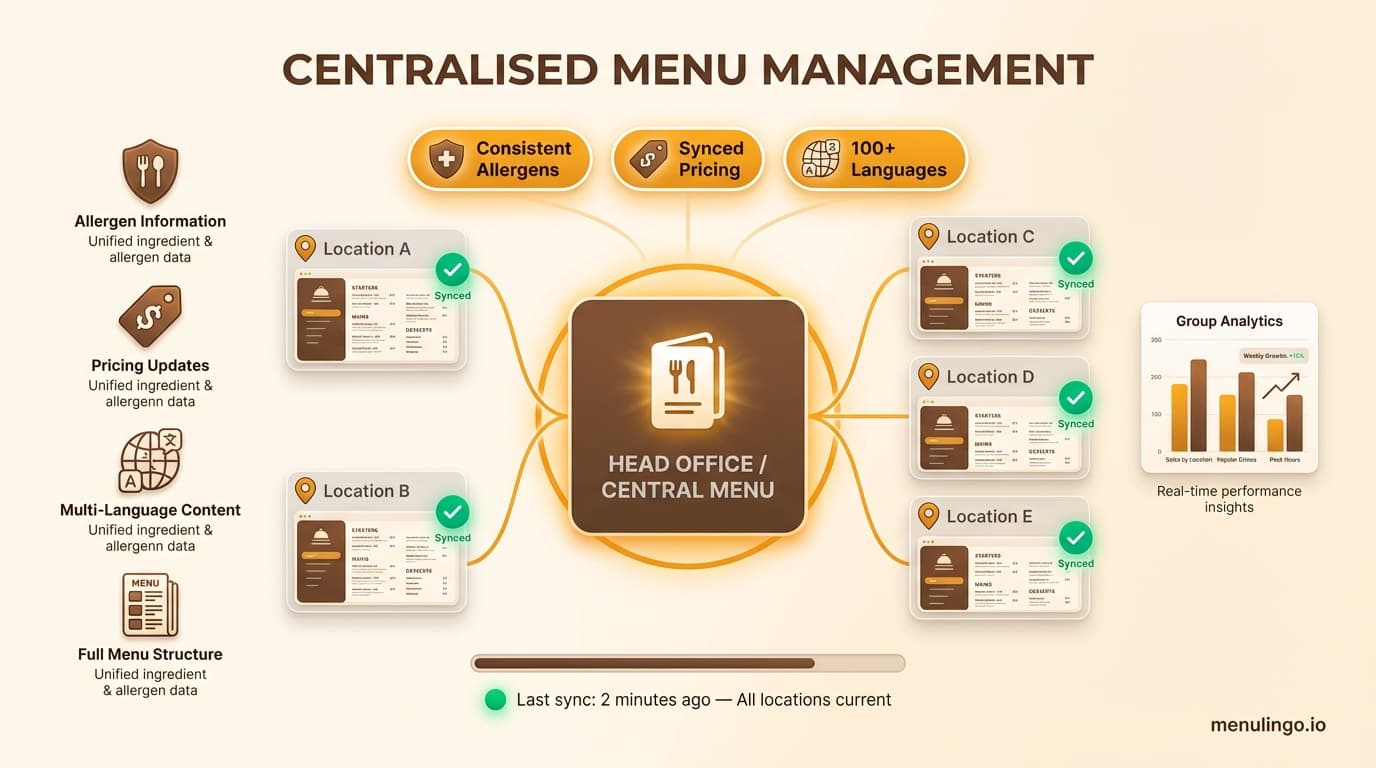
Centralised menu management doesn't mean removing all autonomy from individual locations. It means establishing a single source of truth for menu content, allergen information, and translations — with controlled flexibility for local variations.
Single Source of Truth
A centralised menu management system provides one master menu that all locations reference. When head office changes a dish description, updates an allergen flag, or adjusts a price, the change propagates to every location automatically. No emails, no manual updates, no hoping that the message gets through.
This is the foundational requirement. Without a single source of truth, consistency is a matter of luck rather than process.
Controlled Local Flexibility
Centralisation doesn't mean rigidity. A well-designed multi-location menu system allows:
- Location-specific pricing where markets or costs differ
- Local specials that are managed at the site level but still subject to the central allergen detection process
- Temporary modifications (86'd items, limited availability) that affect one location without disrupting others
The key is that local flexibility operates within the central framework. A local special still gets AI allergen detection. A local price change still appears on the same platform. The system accommodates variation without losing control.
Audit Trail Across Locations
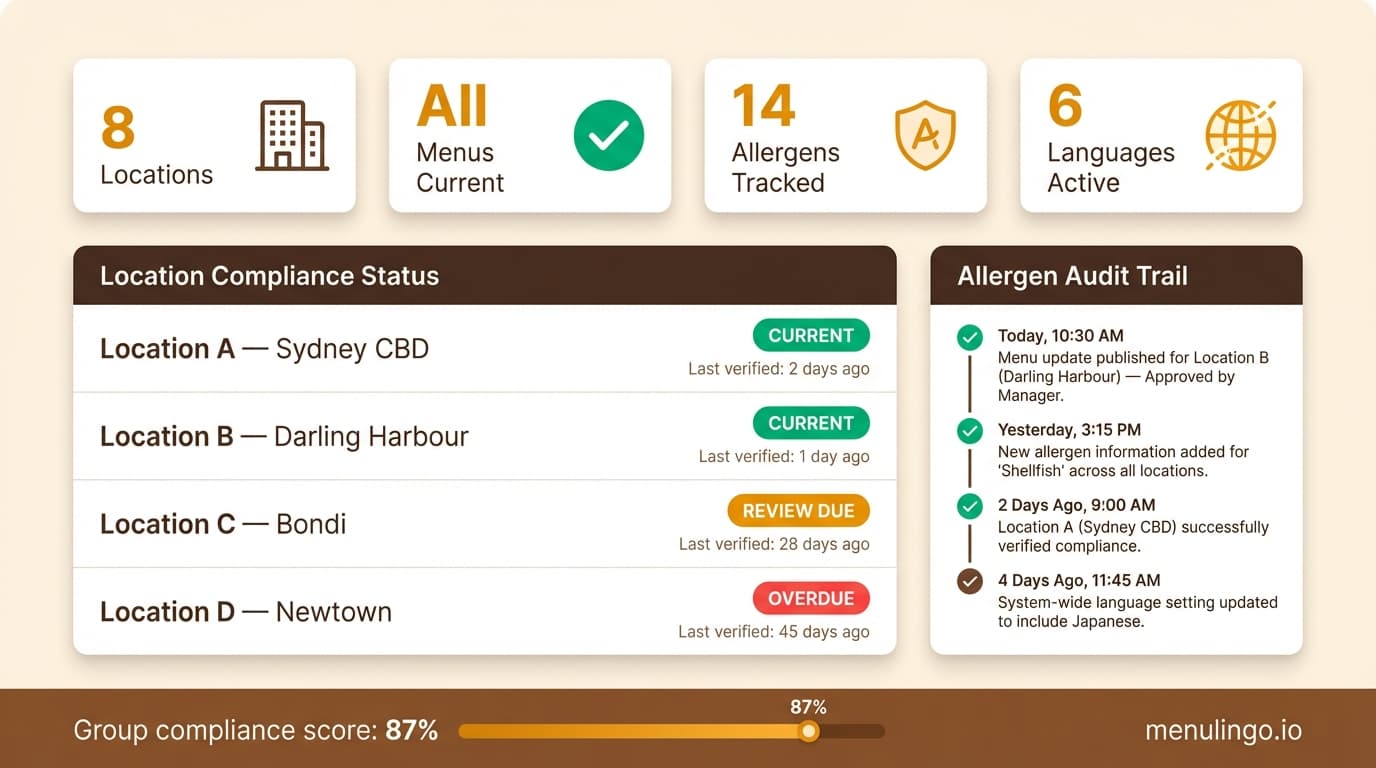
For restaurant groups, the ability to answer "when was this allergen information last verified at Location C?" is not just operationally useful — it's legally important. If an allergen incident occurs, the first question from regulators and lawyers is whether the allergen information was current and who verified it.
A digital platform that logs every change, every verification, and every update provides this audit trail automatically. For each location, you can see exactly when allergen information was last reviewed and by whom. This documentation is significantly more robust than printed charts or verbal confirmation.
Allergen Compliance at Scale
Allergen compliance is the area where multi-location menu inconsistency creates the most serious risk. The regulatory landscape is tightening globally, and food safety authorities in most jurisdictions hold the brand — not just the individual location — responsible for compliance.
The Regulatory Reality
Allergen regulations worldwide require restaurants to provide accurate allergen information. In the EU, Regulation 1169/2011 mandates written allergen disclosure for 14 allergens. In the UK, Natasha's Law and updated FSA guidance push for written allergen information across all food service. In the US, California's SB 68 takes effect in July 2026 for chain restaurants with 20 or more locations.
That last regulation is particularly relevant for multi-location operators. California's law specifically targets chains — the exact businesses most likely to have menu consistency challenges. Meeting SB 68 requirements across 20+ locations without a centralised system would require manual allergen documentation and verification at every single site.
Staff Turnover Multiplied
Hospitality staff turnover is a well-documented challenge. When a restaurant group operates eight locations, each with 15-25 staff, turnover means a continuous cycle of new employees who need allergen training. At any given time, some percentage of staff across the group are in their first weeks and may not fully understand the allergen information system.
A centralised digital menu reduces the risk that staff training gaps create. When allergen information is built into the menu itself — visible to diners without staff intervention — the system doesn't rely on every server at every location knowing every allergen for every dish.
Supplier Variation Between Locations
Different locations may source from different suppliers, even for the same menu item. Bread from Supplier A may contain sesame. Bread from Supplier B may not. If the central menu lists sesame as an allergen in the bread but Location C uses a sesame-free supplier, the information is inaccurate (though in the safe direction). If the reverse happens — the central menu doesn't list sesame but a local supplier's bread contains it — the error is dangerous.
Centralised allergen management with location-level ingredient verification addresses this. The central menu establishes the baseline allergen profile, and individual locations can flag supplier-specific variations that adjust the allergen information for their site.
Translation Management Across Locations
For restaurant groups with locations in tourist areas or diverse markets, multilingual menus add another layer of complexity to multi-location management.
Translation Consistency
If each location independently translates its menu, inconsistencies are inevitable. The same dish might be described differently in Chinese at Location A versus Location B. "Pan-seared duck breast" could translate with different nuances depending on who translated it and when.
Centralised translation management ensures that the same dish has the same translation everywhere. When the central menu is updated, translations are regenerated consistently across all locations. Professional AI translation trained for culinary contexts produces consistent, accurate results that generic tools cannot match.
Language Requirements by Location
Different locations may need different language sets. A restaurant in central Paris needs French, English, Chinese, Japanese, and Arabic. The same brand's location in Barcelona needs Spanish, Catalan, English, French, and Chinese. A location in Sydney needs English, Chinese, Japanese, Korean, and Hindi.
A multilingual menu platform handles this by providing translations in all supported languages from a single menu source. Each location's QR code can default to the local language while offering the full language set to international diners. The restaurant group doesn't need to manage separate translation projects for each location — one menu source produces all the translations needed everywhere.
Revenue Impact
The revenue lost to language barriers compounds across multiple locations. If each of your eight locations loses $500 per week in international diner revenue due to English-only menus, that's $4,000 per week across the group — over $200,000 per year. Centralised multilingual menus recover this revenue consistently across every location.
Digital Menu Benefits for Multi-Location Operations
Beyond allergen and translation management, a centralised digital menu platform provides several operational advantages for restaurant groups.
Brand Consistency
Every location presents the same visual experience to diners. Menu layout, dish descriptions, photography style, and branding are consistent. A diner who visits Location A on Monday and Location B on Thursday recognises the same quality of presentation.
This matters for brand perception. A restaurant group that presents polished, professional menus at every location signals operational excellence. One that presents a mishmash of different formats, outdated PDFs, and inconsistent allergen charts signals the opposite.
Centralised Analytics
When all locations use the same platform, analytics aggregate across the group. Management can see:
- Which dishes are most popular across all locations (and which underperform)
- Which allergen filters are most commonly used (informing menu development)
- Which languages diners request at each location (informing marketing and staffing)
- Which locations have the highest menu engagement
- Whether any location's menu is stale or overdue for review
This data supports better decision-making at both the group level and the individual location level.
Faster Rollouts
When the group adds a new seasonal menu, it can be deployed to all locations simultaneously from the central platform. No courier delivering printed menus to each site, no hoping that the correct version was received, no staggered rollout where some locations are on the new menu and others are still serving the old one.
For restaurant groups that run seasonal menus, promotional specials, or limited-time offers, the speed difference between digital and print deployment is the difference between a coordinated launch and a logistics headache.
QR Code Permanence
A well-designed digital menu system uses permanent QR codes that redirect to the current menu. When the menu changes, the QR code doesn't. This means QR codes at tables never need replacing when the menu updates. For a restaurant group with hundreds of tables across multiple locations, this eliminates a significant recurring cost and operational burden.
Choosing the Right Tier for Multi-Location Operations
Different multi-location scenarios require different levels of platform capability.
Small groups (2-3 locations) may find that a mid-tier plan per location provides sufficient flexibility. Each location manages its own menu within the platform, and consistency is maintained through shared standards and occasional manual verification.
Medium groups (4-10 locations) benefit most from a centralised approach with a higher-tier plan that supports multiple menus per account. This allows head office to manage the master menu while giving individual locations controlled access for local modifications.
Larger groups (10+ locations) need a robust multi-menu, multi-location setup with group-level analytics, centralised allergen management, and location-specific language configurations.
MenuLingo's Business tier supports unlimited menus and unlimited menu items per account, with full multilingual support in 100+ languages — designed for exactly this use case.
Getting Started with Centralised Menu Management
If your restaurant group currently manages menus independently at each location, transitioning to a centralised approach doesn't need to happen all at once.
Phase 1: Audit. Document the current menu management process at each location. Identify where allergen information is stored, when it was last updated, and who is responsible for updates. This audit often reveals more inconsistencies than expected.
Phase 2: Centralise allergen data. Even before switching platforms, establish a single allergen document that all locations reference. Verify this document with your head chef and compliance team. Use our digital menu compliance checklist as a verification framework.
Phase 3: Pilot one location. Set up one location on a dedicated digital menu platform. Run it alongside the existing system for two weeks to verify accuracy and workflow. Gather feedback from staff and diners.
Phase 4: Roll out. Deploy to remaining locations using the pilot location's configuration as a template. Each location's specific adaptations (local specials, supplier variations) are layered on top of the central menu.
Phase 5: Establish ongoing governance. Define who can make changes at which level (head office vs location manager), set review schedules, and configure alerts for stale or unverified allergen information.
Consistent Menus, Protected Brand
Running a multi-location restaurant group means your brand is only as strong as your weakest location. Menu inconsistency, allergen information gaps, and translation problems at any single site can damage the reputation you've built across all of them.
Centralised digital menu management solves this at the system level — not by relying on every person at every location to get it right every time, but by making it structurally difficult to get it wrong.
MenuLingo supports multi-location restaurant menu management with centralised allergen detection, multilingual menus in 100+ languages, and real-time sync across locations. The Business plan ($149/month) includes unlimited menus and locations under one account. View pricing or start your free trial.
Ready to make your menu multilingual?
Join restaurants already serving diners in 9 languages with accurate allergen information. 14-day free trial, no credit card required.
Start Your Free Trial